



Dynamics of the Star-Planet Relations
Aims
This Special Session aims to foster cross-disciplinary studies of Heliophysics and Asterosphysics: the physics of the sun and stars and their environment in the interstellar medium. It raises the question: What can the knowledge we gained in heliophysics bring to the quest for understanding extra-solar systems and the fundamental physical processes in the Asterospheres. And, in return, what can the studies of other stellar systems in our galaxy bring to our understanding of our own stellar system, the Heliosphere. It will review the state-of-the-art of the theoretical, numerical modeling, and space-borne and ground-based observational studies of the dynamics of Sun-Earth relation, Sun-planet relation, and extrasolar star-exoplanet relation, and identify the key problems in these fields to be addressed by astronomy, astrophysics, and space physics communities in the coming years.
Topics
- Perspectives of the dynamics of the Sun-Earth and star-planet relations
- Fundamental physical processes in the stellar-planetary environment
- Stellar-solar variability
- Sun-Earth and star-planet interactions
- Stellar-solar winds: Physics of the asterospheres and the heliosphere
- Interactions of stellar-solar winds with the Local Interstellar Medium
- Prospects: Ground facilities and space missions, theory and simulations
Scientific sessions
SpS10 will consist of 7 Sessions with invited talks: Keynote Talks of 35 min, Review and Topical Talks of 20 or 30 min; plus a poster session dedicated to contributed papers
Educational activities
In addition to scientific sessions, two Public Forums will be held at Peking University and Tsinghua University, on 27 and 29 August 2012, respectively
Rationale:
This Symposium will review the state-of-the-art of the theoretical, numerical modeling, and space-borne and ground-based observational studies of the dynamics of Sun-Earth relation, Sun-planet relation, and extrasolar star-exoplanet relation, and to identify the key problems in these fields to be addressed by astronomy, astrophysics, and space physics communities in the coming years. This is the first effort to bring together three cross-disciplinary communities of IAU: heliospheric astrophysicists, stellar astrophysicists, and exoplanetary astrophysicists to discuss recent progresses in these fields in an integrated manner.
This proposal has the support of key IAU officers in the SOC: Presidents of Divisions II, III, and IV (Sun and Heliosphere, Planetary Systems Sciences, Stars). Presidents of Div. II / Commission 10 (Solar Activity); of Div. II / Commission 12 (Solar Radiation and Structure); of Div. II / Commission 49 (Interplanetary Plasma and Heliosphere); of Div. III / Commission 53 (Extrasolar Planets). Chair of Div. II / WG on International Collaboration on Space Weather. Besides Divs. II, III, and IV, this Symposium can also attract a broad interest in several other IAU Commissions.
Descriptions:
The progress of studies on the dynamics of the star-planet relation has accelerated significantly in the past years. The Sun constantly releases energy into space through electromagnetic and mass emissions. The absorption by the Earth of electromagnetic emissions such as IR and UV radiation from the Sun triggers photosynthesis and makes life possible; it also influences the circulation of currents in the atmosphere and oceans, as well as the formation of cloud, rain, snow and ice which are responsible for climate change. Mass emission in the form of solar wind, via its interaction with the Local Interstellar Medium defines the heliosphere. Transient coronal mass ejections drive interplanetary shocks, which accelerate particles to very high energies and cause magnetic storms on planets. Solar activity is controlled by the magnetic fields generated by its dynamo that exhibits solar cycles varying with an average cycle of eleven years.The planetary-exoplanetary environment refers to the regions of planetary and exoplanetary atmospheres, which are influenced by the physical conditions in solar and extrasolar stellar wind, respectively. The recent discovery of exoplanets has led to a rapid advance in the theoretical understanding of stellar and planetary formation and evolution, and the implementation of dedicated observational programs of exoplanets, including the search for radio emissions from exoplanets. The planetary environment in the solar system has been explored in situ by a large number of spacecraft and analyzed extensively by ground-based observations. These experimental observations have been verified in detail by analytical theories and numerical simulations. Our knowledge of the physical processes occurring in the nearby planetary environment provides the basic tools for our investigation of the complex physical processes taking place in the distant exoplanetary environment in extrasolar systems.
The planetary magnetospheres of the solar system come in many forms and sizes. A comparative study of planets helps us to reconstruct the past history and predict the future evolution of the Earth. Planetary science allows us to contrast the properties of the Earth's environment with the environment of other planets, to reveal how planetary magnetospheric-ionospheric-atmospheric processes respond to changes of planetary scale and rotation rate and of solar wind structure in the vicinity of the planet.
The study of exoplanets is one of the priority research areas of astronomy and astrophysics today. It aims to discover Earth-like exoplanets, and to search for signs of habitability and evidence of biosignatures. One of the fundamental requirements for the planet habitability is the existence of a planetary magnetosphere and a planetary atmosphere. The Earth's magnetosphere and atmosphere prevent harmful galactic cosmic rays from reaching the Earth's surface, without which human life may be in jeopardy. It is natural to expect that the exoplanetary environment exhibits a huge diversity of dynamics and structures.
Many exoplanetary systems possess planets that are located very close to their host stars, the most common example being the hot Jupiters. This configuration leads to strong tidal effects, both on the planetary system and on the central star, which need to be understood to constraint the formation and evolution processes of these systems. The surprising discovery of 51 Peg-b in 1995, then the subsequent evidence that a population of similar hot gas giants is a prominent feature of exoplanetary systems, indicated that the solar system is by no means to be taken as a template, and that dynamical migration is a crucial element to take into account in the modeling of planetary system evolution. Present space-borne and ground-based surveys, using facilities such as the CoRoT or Kepler satellites or the Harps ultra-stable spectrograph at ESO-La Silla, as well as future developments, such as the Espresso spectrograph on the VLT and the ESA PLATO satellite, will provide us with a solid statistical knowledge of planetary systems, and strong constraints for further modeling of their dynamical evolution.
The magnetic interactions of solar-stellar winds with planetary-exoplanetary magnetospheres leads to energetic electrons resulting from magnetic reconnections in the planetary-exoplanetary environment, with the consequent emission of nonthermal planetary-exoplanetary radio waves. A variety of intense nonthermal planetary radio emissions are known in the solar system, e.g., the auroral radio emissions from Earth, Jupiter, Saturn, Uranus and Neptune, and the radio bursts from the Io-Jupiter flux tube. The former is thought to be driven by the solar wind flow pressure or energy flux on the magnetospheric cross-section, while the latter is a product of the Io-Jupiter electrodynamic interaction. Some studies that examined the possibility of radio emissions from exoplanets have concluded that hot Jupiters, if magnetized, might emit strong radio emissions detectable by large ground-based low-frequency antenna arrays.
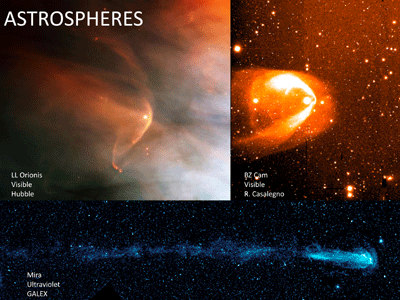
The interaction of the astrosphere with its Local Interstellar Medium is expected to strongly influence the size and shape of the astrosphere. Recently with the exciting measurements from the two Voyager spacecraft and IBEX we learned how the heliosphere is shaped by the interstellar magnetic field and nonthermal processes. These ideas will certainly fertilize and carry to other astrospheres.
The star-planet relation exhibits the behaviors of a complex system governed by a rich variety of dynamical and nonlinear phenomena. The aim of this IAU Symposium is to present a review of the state-of-the-art of the theoretical, numerical modeling, and space-borne and ground-based observational studies of the dynamics of Sun-Earth relation, Sun-planet relation, and extrasolar star-exoplanet relation, and to identify the key problems in this field to be addressed by astronomy, astrophysics, and space physics communities in the coming years. In particular, this Symposium will discuss the implications of the recent advances in this field for the preparation of main future space missions involving space agencies and programs worldwide, e.g., ILWS (International Living with a Star), CNSA (Chinese National Space Agency), ESA (Japanese Space Agency), JAXA (Japanese Aerospace Exploration Agency), NASA (National Aeronautics and Space Administration), and the contribution of the astronomical and astrophysical communities in international programs on the study of the impact of solar variability on climate change such as the CAWSES-II (Climate and Weather of the Sun-Earth System) program of SCOSTEP (Scientific Committee on Solar-Terrestrial Physics) of ICSU (International Council for Science).
Program:

- Session I: Overview of the star-planet relations
- Session II: Physical processes in the stellar-planetary environment
- Session III: Stellar-solar variability
- Session IV: Sun-planet relations
- Session V: Star-planet relations
- Session VI: Heliosphere and Asterospheres
- Session VII: Perspectives of the star-planet relations
- Public Forum I on "The Sun-Planet Relations" at Peking University
- Public Forum II on "The Star-Planet Relations" at Tsinghua University
« SpS10 Dynamics of the star-planet
relations » FINAL
PROGRAM, version 11 (3 July 2012)
Session I: Overview of the star-planet relations (2 h)(Monday, Aug. 27, 10:30-12:30)
Chairs: Jean-Louis Bougeret and Xueshang Feng
|
Time |
Title |
Speaker |
|
10:30-10:35 |
Opening |
Jean-Louis
Bougeret |
|
10:35-10:45 |
Communicating Heliophysics with the public (invited) |
Carine
Briand |
|
10:45-11:20 |
Keynote talk on "The Heliosphere" (invited) |
John
Richardson |
|
11:20-11:55 |
Keynote talk on "The Asterospheres" (invited) |
Jeffrey
Linsky |
|
11:55-12:30 |
Keynote talk on "Sun-Earth and star-planet relations" (invited) |
Sami Solanki |
Session II: Physical
processes in the stellar-planetary environment, part 1 (1.5 h)(Monday,
Aug. 27, 14:00-15 :30)
Chairs: Sandra Chapman and Lin-Ni
Hau
|
Time |
Title |
Speaker |
|
14:00-14:30 |
Magnetic
reconnection and particle acceleration - A review (invited) |
James
Drake |
|
14:30-14:50 |
Conditions for the onset of magnetic reconnection deduced from solar wind
observations (invited) |
Tai
Phan |
|
14:50-15:10 |
Physics of thin current sheet and
magnetic reconnection (invited) |
Lin-Ni
Hau |
|
15:10-15:30 |
Cross-scale
coupling in space plasmas: lessons from multi-spacecraft (invited) |
Malcolm
Dunlop et al. |
Session II: Physical
processes in the stellar-planetary environment, part 2(2 h)(Monday, Aug. 27, 16:00-18:00)
Chairs: Sandra Chapman and Lin-Ni
Hau
|
Time |
Title |
Speaker |
|
16:00-16:20 |
Energetic particles in the heliosheath (invited) |
Randy Jokipii |
|
16:20-16:40 |
Impact of the nonuniformity/nonstationarity
of a perpendicular shock front on ions dynamics (invited) |
Bertrand
Lembège et al. |
|
16:40-17:00 |
Nonlinear
dynamics of relativistic electrons interacting with whistler-mode chorus
emission and EMIC triggered emissions in the planetary magnetosphere (invited) |
Yoshiharu Omura |
|
17:00-17:20 |
Solar magnetic
field (invited) |
Jie Jiang |
|
17:20-17:40 |
MHD turbulence in the solar wind (invited) |
Qing-Yu Luo et al. |
|
17:40-18:00 |
Characterisation
of exoplanet atmospheres, magnetospheres and stellar winds from energetic
neutral atom observations (invited) |
M. Holmstrom et al. |
Public Forum I on "The Sun-Planet Relations" at Peking
University (2 h) (Monday, August 27, 20:00-22 :00)
Chairs:
S. Fu, J.-L. Bougeret, and A. Chian
|
Time |
Title |
Speaker |
|
20:00-20:15 |
Solar magnetic
cycles (invited) |
Alan
Sacha Brun |
|
20:15-20:30 |
Origin of the solar wind (invited) |
Chuanyi Tu |
|
20:30-20:45 |
Sun-Earth and star-planet relations (invited) |
Sami Solanki |
|
20:45-21:00 |
The heliosphere
(invited) |
John
Richardson |
|
21:00-21:15 |
The asterospheres
(invited) |
Jeffrey
Linsky |
|
21:15-21:30 |
Laboratory experiments of astrophysical phenomena (invited) |
Hideaki Takabe |
Session III: Stellar-solar variability (2 h) (Tuesday,
Aug. 28, 10:30-12:30)
Chairs:
Christopher Corbally and Valentin Martinez Pillet
|
Time |
Title |
Speaker |
|
10:30-11:00 |
Solar magnetic
cycles (invited) |
Alexander
Kosovichev |
|
11:00-11:30 |
From quiet to active inner Sun : what are the consequences on
Sun-planet Relationship (invited) |
Sylvaine
Turck-Chièze |
|
11:30-11:50 |
From helioseismology to asteroseismology (invited) |
Jørgen Christensen-Dalsgaard |
|
11:50-12:10 |
Dynamic coupling between the photosphere and
chromosphere revealed with HINODE (invited) |
Yukio Katsukawa |
|
12:10-12:30 |
Sunspots
and Starspots: Cut from the same cloth? (invited) |
Svetlana
Berdyugina |
|
|
|
|
|
POSTERS |
|
|
|
|
Inspection for secular variation of Earth's rotation inferred from
Chinese ancient astronomical records |
Yong
Li |
|
|
A physical reconstruction of solar
magnetic field since 1700 |
Jie Jiang et al. |
Session IV: Sun-planet relations (1.5 h)(Tuesday,
Aug. 28, 14:00-15:30)
Chairs:
A. Boss and N. Gopalswamy
|
Time |
Title |
Speaker |
|
14:00-14:30 |
Multi-spacecraft observations of solar wind-magnetosphere interactions
(invited) |
Hiroshi
Hasegawa |
|
14:30-14:50 |
A 3-D magnetohydrodynamic simulation of
the correspondence of EIT and CME induced waves (invited) |
S. T. Wu and C.C. Wu |
|
14:50-15:10 |
Acceleration and deceleration of Coronal Mass Ejection and its driven
shock (invited) |
Chin-Chun
Wu et al. |
|
15:10-15:30 |
3D MHD numerical study of two CMEs' evolution and their interaction |
Fang
Chen et al. |
|
|
|
|
|
POSTERS |
|
|
|
|
Solar flares generated by impacts of comets with the Sun |
Firuz Ibodov and Subhon Ibadov |
|
|
The star-planet interaction: 3D gas dynamic simulation of the flow structure
in the vicinity of the hot Jupiter |
Dmitry Bisikalo
et al. |
|
|
Solar excitation of millennial Earth rotation oscillations |
Yavor Chapanov
et al. |
|
|
Langmuir waves associated with type III bursts and impulsive electron
events |
Sonja Vidojevic et al. |
|
|
The space weather and geomagnetic storms
program of the ON/MCTI - instrumental network, plans and first findings |
Alexandre
Humberto Andrei et al. |
|
|
Significant
variability in the Sun-Earth interaction events during solar cycles 23 and 24 |
Nat Gopalswamy et al. |
|
|
Venus
transit : preliminary data on solar diameter |
Costantino Sigismondi and Xiaofan Wang |
|
|
Earth-based detection of Uranus' aurorae |
Laurent
Lamy et al. |
|
|
Observation
of unusual burst at decameter wavelengths |
Valentin
Melnik |
Session V: Star-planet
relations, part 1(2 h)(Tuesday,
Aug. 28, 16:00-18:00)
Chairs:
A. Boss and N. Gopalswamy
|
Time |
Title |
Speaker |
|
16:00-16:30 |
Star-planet interactions in a stellar-planetary system (invited) |
Annie Baglin |
|
16:30-17:00 |
Solar System evolution and the diversity
of planetary systems (invited) |
Patrick Michel and Alessandro Morbidelli |
|
17:00-17:20 |
Planets at very wide orbits from
re-capture of free floating planets |
Thijs Kouwenhoven and Hagai Perets |
|
17:20-17:40 |
Interaction between a close-in exoplanet
with the magnetosphere of its host star: planetary migration and inflation |
Randy Laine and Douglas Lin |
|
17:40-18:00 |
Single evolved stars with enhanced
rotation: A signature of planetary accretion? |
Bruno
Canto Martins et al. |
Session V: Star-planet
relations, part 2(2 h)(Wednesday,
Aug. 29, 10:30-12:30)
Chairs:
A. Boss and N. Gopalswamy
|
Time |
Title |
Speaker |
|
10:30-10:50 |
Bow shocks around exoplanets (invited) |
Aline Vidotto et al. |
|
10:50-11:10 |
Physics and evolution of the stellar
winds from low to intermediate stars (invited) |
Takeru Suzuki |
|
11:10-11:30 |
Observation and modelling of transits and starspots in the WASP-19
planetary system |
Jeremy
Tregloan-Reed |
|
11:30-11:50 |
Modeling stellar granulation as seen in
disk-integrated intensity |
Réza Samadi
et al. |
|
11:50-12:10 |
Spectrophotometric explorations of
chromospheric activity variations for star systems with exoplanets |
Yuliana Kuznyetsova
et al. |
|
12:10-12:30 |
Jupiter's polar activities driven
by high-speed magnetized solar winds (invited) |
Yu-Qing Lou |
|
|
|
|
|
POSTERS |
|
|
|
|
Periodic orbits in the Chermnykh-Like problem with oblateness |
Badam
Singh Kushvah |
|
|
Zero velocity surfaces and linear stability of triangular equilibrium
points in the generalized photogravitational Chermnykh-like problem with power-law
profile |
Ram Kishor and Badam Singh Kushvah |
|
|
Internal structure and geometrical
flattening of mantle and liquid core of the Moon |
Alexander
Gusev |
|
|
Connection between the solar activity and
the Earth's rate of rotation |
Dusan Marceta and Stevo Segan |
|
|
Effects of radiation on the geometry of
zero-velocity surfaces in the photo-gravitational circular restricted 3-body
problem |
Dusan Marceta et al. |
|
|
Investigation of some transiting
exoplanet systems |
Viktoriia Krushevska et al. |
|
|
Calibration in the ultraviolet : the
FONDUE star catalog |
Aurélie Reberac and the FONDUE team |
|
|
The fate of planetary systems in open
clusters |
X.C. Zheng and Thijs Kouwenhoven |
|
|
The dynamical evolution of Brown Dwarf
systems formed from disk fragmentation |
Yun Li
et al. |
|
|
The
influence of terrestrial planet formation in the observed chemical anomalies
in the Sun |
Jorge Melendez |
|
|
Whether planet systems affect stars'
initial rotation velocities and the Lithium abundance |
Ge Zhishuai |
|
|
Asteroseismology analysis of host stars
with exoplanets observed by Kepler |
Zhijia Tian et al. |
|
|
Gravitational field's description and
dynamical laws of the fields' interaction |
Ji Luo |
Session VI:
Heliosphere and Asterospheres,part 1(1.5 h) (Wednesday, Aug. 29, 14:00-15:30)
Chairs:
Rosine Lallement, Brian Wood and Vlad Izmodenov
|
Time |
Title |
Speaker |
|
14:00-14:20 |
Multi-component nature of the SW/LISM
interaction : models vs. Observations (invited) |
Vladislav
Izmodenov |
|
14:20-14:35 |
Magnetic reconnection in the heliosheath
and its signatures and consequences (invited) |
James
Drake et al. |
|
14:35-14:50 |
Modeling
of heliosphere and magnetic reconnection in the heliosheath (invited) |
Merav Opher
et al. |
|
14:50-15:10 |
The heliosphere and the interplanetary
ultraviolet background (invited) |
Eric Quémerais |
|
15:10-15:30 |
Effects of the solar wind-LISM
interaction on the properties of backscattered solar Lyman-alpha radiation
measured by SOHO/SWAN |
Olga Katushkina et al. |
Session VI: : Heliosphere and
Asterospheres,part 2(2 h) (Wednesday,
Aug. 29, 16:00-18:00)
Chairs:
Vlad Izmodenov, Rosine Lallement and Brian Wood
|
Time |
Title |
Speaker |
|
16:00-16:20 |
The Astrospheres of Sun-like stars (invited) |
Brian
Wood |
|
16:20-16:40 |
Recent discoveries and investigations
into infrared bow shocks between stellar winds and the ISM (invited) |
Toshiya Ueta |
|
16:40-17:00 |
Dust in bow shocks and shells :
Probing the interaction between stellar winds and the ISM (invited) |
Nick
Cox et al. |
|
17:00-17:20 |
Radio observations of the interfaces
between red giant stellar outflows and the ISM (invited) |
Thibault
Lebertre et al. |
|
17:20-17:40 |
Multiple interaction features in the slow
and dusty winds of AGB stars (invited) |
Andreas
Mayer et al. |
|
17:40-18:00 |
The interaction between the runaway O
star HD34078 (AE Aurigae) with the surrounding molecular cloud (invited) |
Pierre
Gratier et al. |
Public Forum II on "The Star-Planet Relations" at
Tsinghua University (2 h)(Wednesday, August 29, 20:00-22:00)
Chairs:
Y.-Q. Lou, A. Chian, and K. Meech
|
Time |
Title |
Speaker |
|
20:00-20:15 |
The interior of stars (invited) |
Sylvaine
Turck-Chièze |
|
20:15-20:30 |
Stellar-planetary dynamos (invited) |
A. Brandenburg |
|
20:30-20:45 |
Stellar wind evolution and its effect on planets (invited) |
Brian
Wood |
|
20:45-21:00 |
Sun-planet
relations (invited) |
W.-H. Ip |
|
21:00-21:15 |
Star-planet interactions in a stellar-planetary system (invited) |
Annie Baglin |
|
21:15-21:30 |
Observation and characterization of exoplanet's
atmosphere-magnetosphere environment (invited) |
Helmut
Lammer |
Session VI:
: Heliosphere and Asterospheres,part 3(2 h) (Thursday, Aug. 30, 10:30-12:30)
Chairs:, Brian Wood, Vlad Izmodenov and Rosine Lallement
|
Time |
Title |
Speaker |
|
10:30-10:50 |
The role of stellar plasma interaction in
terrestrial planetary atmosphere evolution (invited) |
Helmut
Lammer et al. |
|
10:50-11:10 |
The wind effects of weak-lined T Tauri stars on the environment of
extrasolar planets (invited) |
Vera Jatenco-Pereira et al |
|
11:10-11:30 |
Probing the stellar plasma environment around
exoplanets via Energetic Neutral Atom modeling (invited) |
Kristina
Kislyakova et al. |
|
11:30-11:50 |
Space weather at small distances from the
Sun and in extra-solar planet environment (invited) |
Merav Opher |
|
11:50-12:10 |
Physics and evolution of the stellar
winds (invited) |
Moira
Jardine |
|
12:10-12:30 |
Numerical simulation and nonlinear
dynamics of turbulent dynamos (invited) |
Erico Rempel
et al. |
|
|
|
|
|
POSTERS |
|
|
|
|
How does merging affect the CMIR-driven shocks
as they propagate into the heliosheath? |
Elena Provornikova et al. |
|
|
Astrosphere or Asterosphere? |
Jean-Louis
Bougeret |
Session
VII: Perspectives of the star-planet
relations, part 1(Friday, Aug. 31, 8:30-10:00)
Chairs:
A. Chian, G. Qin, and N. Vilmer
|
Time |
Title |
Speaker |
|
08:30-08:45 |
Future programs in star-planet relations (invited) |
Magali
Deleuil |
|
08:45-09:05 |
Will superfares occur on our Sun? (invited) |
Kazunari Shibata |
|
09:05-09:25 |
Laboratory experiments of shocks and magnetic
reconnections (invited) |
Yasuhiro Kuramitsu
et al. |
|
09:25-09:45 |
Magnetic twist : a source and
property of space weather |
Joern Warnecke
et al. |
|
09:45-10:00 |
Coronal magnetic topologies and dynamics
of interplanetary electrons |
Chuan
Li et al. |
Session
VII:Perspectives of the star-planet
relations, part 2(Friday, Aug. 31, 10:30-12:30)
Chairs:
A. Chian, G. Qin, and N. Vilmer
|
Time |
Title |
Speaker |
|
10:30-10:50 |
Particle
acceleration and transport in the Heliosphere (invited) |
Gang
Li |
|
10:50-11:10 |
Dispersive
Alfvénic turbulence in solar-terrestrial
relations |
Yuriy Voitenko and Johan De Keyser |
|
11:10-11:30 |
Signatures of Coronal Mass Ejections in
the Heliosphere (invited) |
Nat Gopalswamy |
|
11:30-11:50 |
Are CMEs really mass motions? (invited) |
Peng-Fei
Chen |
|
11:50-12:10 |
CMEs and the buildup of magnetic flux in
the Heliosphere |
David
Webb et al. |
|
12:10-12:30 |
Perspective
of future space- and ground-based projects for solar observations in China (invited) |
Yihua Yan |
|
|
Closing |
SOC chairs |
SOC:
- Jean-Louis Bougeret, Paris Observatory, France
(jean-louis.bougeret@obspm.fr): Chair - Abraham C.-L. Chian, National Institute for Space Research - INPE, Brazil and Paris Observatory, France (abraham.chian@obspm.fr): co-chair
- Xueshang Feng, Center for Space Science and Applied Research - CSSAR, China (fengx@spaceweather.ac.cn): co-chair
- Merav Opher, Boston University, USA (mopher@gmu.edu): co-chair
- Alan P. Boss, Carnegie Institution of Washington, USA (boss@dtm.ciw.edu)
- Sandra C. Chapman, University of Warwick, UK (s.c.chapman@warwick.ac.uk)
- Christopher J. Corbally, University of Arizona, USA (corbally@as.arizona.edu)
- Cheng Fang, Nanjing University, China (chenpf@nju.edu.cn)
- Nat Gopalswamy, NASA Goddard Space Flight Center, USA (nat.gopalswamy@nasa.gov)
- Zoran Knezevic, Astronomical Observatory of Belgrade, Serbia (zoran@aob.rs)
- Alexander Kosovichev, Stanford University, USA (sasha@quake.stanford.edu)
- Valentin Martínez Pillet, Instituto de Astrofísica de Canarias, Spain (vmp@iac.es)
- Karen J. Meech, University of Hawaii Honolulu, USA (meech@ifa.hawaii.edu)
- Heike Rauer, DLR Institute of Planetary Research, Berlin, Germany (heike.rauer@dlr.de)
- Kazunari Shibata, Kyoto University, Japan (shibata@kwasan.kyoto-u.ac.jp)
- David F. Webb, Boston College, Chestnut Hill, MA, USA (david.webb.ctr@hanscom.af.mil)
Registration:
For details of registration, please visit the IAU General Assembly at www.astronomy2012.org.
Participants:
Coming soon...
Public Forums:
In collaboration with WISER and the two leading universities in China, we will organize two Public Forums during the period of the IAU GA in Beijing. One on the campus of Peking University and the other on the campus of Tsinghua University. These two events will be held in the evenings and will be open to students and teachers from high schools, students and professors from universities, and the general public. A panel consisting of selected invited speakers, and members of SOC and LOC, of the 2012 GA IAU Symposium on "Dynamics of the Star-Planet Relation", will present introductory talks on recent advances in the study of the star-planet relation. A large participation is expected for each Public Forum.
LOC for the Educational Activities:
- Gang Qin, Center for Space Science and Applied Research - CSSAR, China (gqin@spaceweather.ac.cn): Chair
- Peng-Fei Chen, Nanjing University, China (chenpf@nju.edu.cn)
- Dr. Suiyan Fu, Peking Univeristy, China (suiyanfu@pku.edu.cn)
- Dr. Yu-Qing Lou, Tsinghua University, China (louyq@mail.tsinghua.edu.cn
- De-Jin Wu, Purple Mountain Observatory, China (djwu@pmo.ac.cn)
- Yihua Yan, National Astronomical Observatories, China (yyh@bao.ac.cn)
 |  | |
| [pdf] | [pdf] |
Contact:
- Jean-Louis Bougeret, Paris Observatory, France
(jean-louis.bougeret@obspm.fr) - Abraham C.-L. Chian, National Institute for Space Research - INPE, Brazil and Paris Observatory, France (abraham.chian@obspm.fr)
- Xueshang Feng, Center for Space Science and Applied Research - CSSAR, China (fengx@spaceweather.ac.cn)
- Merav Opher, Boston University, USA (mopher@gmu.edu)