Venus coordinated campaign
This wiki is provided as a tool to share information and schedules for the coordinated observations in support of ESA/Venus Express, JAXA/Akatsuki and ground-based Venus exploration development plans. Last updated Oct. 10, 2011 - TW
What's New ?
Nov. 2011 - Third JSPS/PHC Sakura meeting, ISAS, Sagamihara Campus, November 21-22, 2011. Added meeting agenda and report. - T.W.
October 2011 - Added a DPS/EPSC virtual poster session section. New section for the 2012 transit of Venus coordination campaign. Added links to the VEXAG website and future meetings - T.W.
June 2011 - Added files 2010_Campaign_5.pdf and .jpg. Now includes coordination summary up to June-July 2011. - T.W.
June 2011 - now includes planning overview poster for Jan 2012 - April 2013. - C.W.
Nov. 21, 2010 - Scheduled ground-based observations updated. Includes MTP 63-64 planned campaign 25 Feb – 15 March 2011. - T.W.
Circumstances of Venus coordinated campaigns
Scheduled ground-based observations

- Ground-based campaign, Jul. 2010 - Jan. 2012
- Editable Google spreadsheet for detailed observing circumstances
- 2010 | Detailed observing circumstances (Editable Google spreadsheet)
- Circumstances of Venus observation from Earth, 2010-2014
HST observations
- Venus observing by HST:File:HST-soir overlap.txt
VEx - ground-based coordination files

- VEx science operations, Jul. 2010 - Jan. 2012, VSOC team :
- VEx science operations, Jan. 2012 - April 2013, VSOC team :
- SOIR Files:
This file lists all SOIR observations made from the beginning of Venus operations (April 2006) until September 2010.
For further details, contact the SOIR Principal Investigator: Ann-Carine Vandaele <A-C.Vandaele@aeronomie.be>
These files describe SOIR solar occultation opportunities in the period 30/7/2010 - 25/8/2011 and 1/1/2012-31/12/2012 respectively. SOIR occultations allow measurement of gas abundances and temperatures in the 80-150 km altitude region.
For further details, contact SOIR Principal Investigator: Ann-Carine Vandaele <A-C.Vandaele@aeronomie.be>.
- VeRa Files:
This file descibes all VeRa radio occultations carried out in the period 1/7/2006 - 2/6/2010.
For further information contact the VeRa team: Martin Paetzold <Martin.Paetzold@uni-koeln.de>, Bernd Hauesler <Bernd.Haeusler@unibw.de>, and Silvia Tellmann <tellmann@geo.uni-koeln.de>
This file describes the future opportunities for Radio occultations in the upcoming occultation seasons in January 2011 - January 2012. File kindly provided by Stefan Remus, ESAC.
For further information contact the VeRa team: Martin Paetzold <Martin.Paetzold@uni-koeln.de>, Bernd Hauesler <Bernd.Haeusler@unibw.de>, and Silvia Tellmann <tellmann@geo.uni-koeln.de>.
Coordination meetings / meeting sessions
Past and future workshops / Meeting sessions
- Japan Geoscience Union (JpGU) Meeting, 20-25 May, 2012, Makuhari Messe, Japan.
- Third JSPS/PHC Sakura meeting, ISAS, Sagamihara Campus, November 21-22, 2011.
- Meeting agenda: File:3rdmeeting.pdf
- Meeting picture:
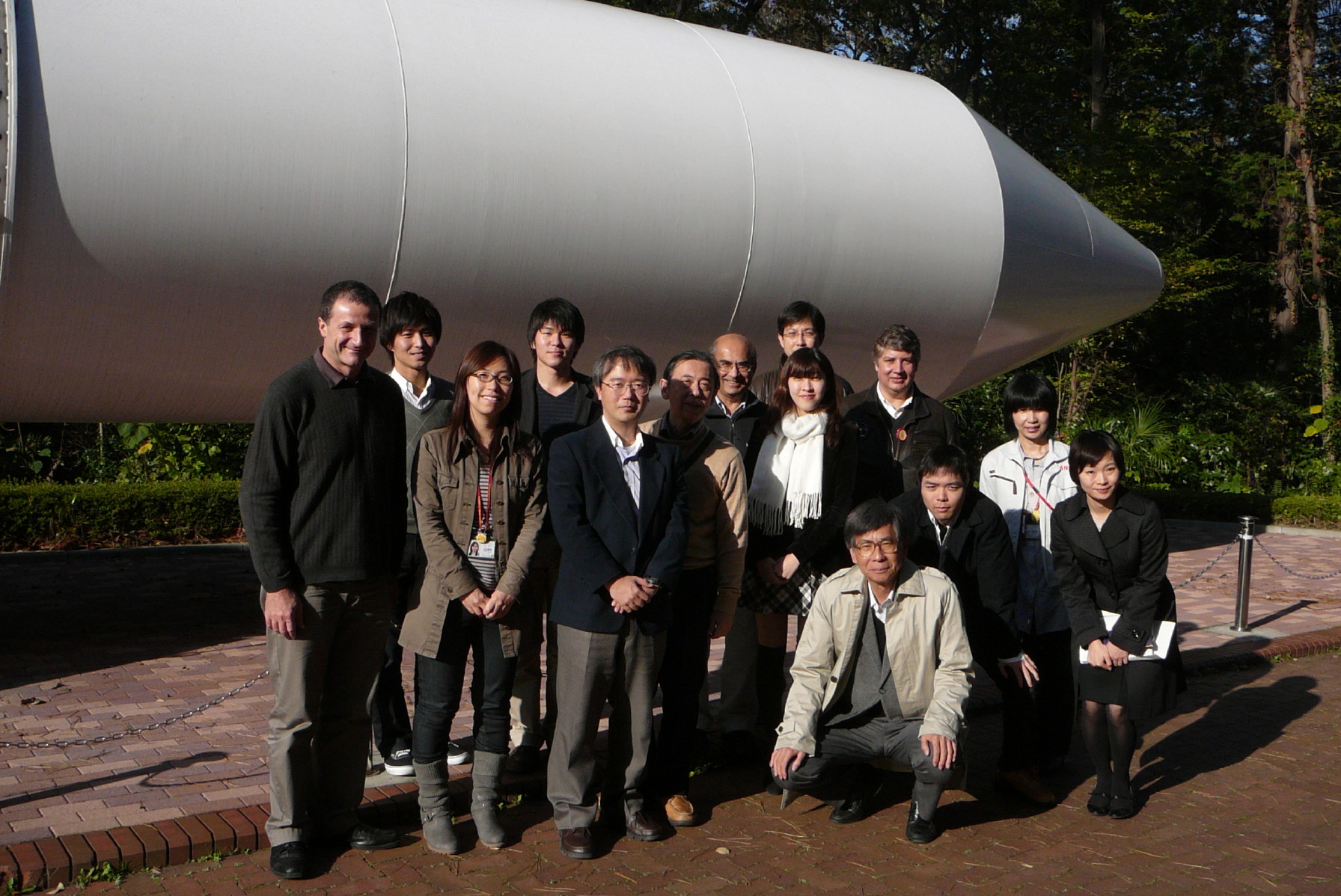
- Meeting minutes/report: File:3rdSakuraReport.pdf

- VEx Science Working Team Meeting, 16-18 November 2011, Graz, Austria
- Atmospheric waves workshop, 9-10 November 2011, ESTEC, Noordwijk, NL
- VEXAG International Venus Workshop, Smithsonian Steven F. UdvarHazy Center, Dulles Airport, Washington DC 30 August - 1 September 2011
- Second JSPS/PHC Sakura meeting, University of Tokyo, Space science building, December 3, 2010.
- 2010 VEXAG International Workshop: Venus, Our Closest Earth-like Planet, Madison (USA), 30 August - 2 September 2010
- « After-Aussois Venus 2010 » workshop: 1st strategic workshop on Coordinated ground-based measurements and modeling of the Venus atmosphere, Paris, June 28-29, 2010
- Venus Conference, Aussois (France), 20-26 June 2010
- First JSPS/PHC Sakura meeting, ISAS, Sagamihara Campus, February 23-25, 2010.
EPSC/DPS Nantes Oct. 2011 - Venus virtual poster session
- Machado et al. 2011, Characterization of Venus' cloud top dynamics using ground-based Doppler spectroscopy
- Peralta et al. 2011, Solar Tides in the Winds of the Southern Polar Region of Venus using VIRTIS-M/VEx Images
- Sonnabend et al. 2011, Thermospheric/Mesospheric Temperatures on Venus : Comparison between Ground-based High-Resolution Spectroscopy of CO2 and other Techniques
- Stangier et al. 2011, Investigation of CO2 Absorption Features on Venus
 Machado et al. 2011 Characterization of Venus' cloud top dynamics using ground-based Doppler spectroscopy File:Machado-Nantes.pdf |
 Peralta et al. 2011 Solar Tides in the Winds of the Southern Polar Region of Venus using VIRTIS-M/VEx Images File:Peralta-Nantes.pdf |
 Sonnabend et al. 2011 Thermospheric/Mesospheric Temperatures on Venus : Comparison between Ground-based High-Resolution Spectroscopy of CO2 and other Techniques File:Sonnabend-Nantes.pdf |
 |
| File:Machado-Nantes.pdf | File:Peralta-Nantes.pdf | File:Sonnabend-Nantes.pdf | File:Stangier-Nantes.pdf |
Detailed instrumental characteristics
Ground-based facilities
Clickable map of observatory sites and telescope facilities, with a link to their instruments.
- 2010 Venus Coordinated Campaign, Telescopes sites (editable Google map)
<googlemap version="0.9" lat="5.266008" lon="81.5625" type="terrain" zoom="2" controls="large"> http://www.lesia.obspm.fr/venus-atm/2010venus.kml </googlemap>
- Sunspot Astronomy & Visitor Center
- Observatorio SOAR
- Observatoire du Pic du Midi de Bigorre
- Osservatorio Astronomico della Regione Autonoma Valle d'Aosta
- South African Astronomical Observatory
- Southern African Large Telescope (SALT)
- Hanle Observatory
- 4 TAOS robotic
- Naroyo Observatory
- Naroyo 1.6-m
- Siding Spring Observatory
- 1 m McLellan
- MOA 1.8-m
- 0.6-m Optical Craftsmen
- 0.6-m Boller & Chivens
- Mauna Kea Observatory
- Haleakala Observatory
- THIS Tuneable Heterodyne Infrared Spectrometer
used at the:
- - McMath-Pierce Solar Telescope on Kitt Peak in Arizona
- - IRTF on Mauna Kea Hawaii
- HIPWAC Heterodyne Instrument for Planetary Wind And Composition at IRTF
Venus Express instruments

- SPICAV/SOIR : Ultraviolet and Infrared Atmospheric Spectrometer
Atmospheric spectrometry by star or Sun occultation
UV 0.11 - 0.3 µm R ~ 300
IR 0.7 - 1.7 µm R ~ 1300
SOIR 2.3 - 4.2 µm R ~ 15000
- VeRa : Venus Radio Science Experiment
Radio sounding of atmosphere
- VIRTIS : Ultraviolet/Visible/Near-Infrared mapping spectrometer
Spectrographic mapping of atmosphere and surface
- VIRTIS-M mapping spectrometer
Vis 0.25 - 1.0 µm R ~ 100 - 200 ( IR 1 - 5 µm R ~ 100 - 200 )
- VIRTIS-H High-res
2 - 5 µm R ~ 1000 - 2000
- VMC : Venus Monitoring Camera
Ultraviolet and visible imaging
Filters :
UV 0.365 µm
Vis 0.513 µm
Near - IR1 0.965 µm
Near - IR2 1.010 µm
More about the Venus Express Instruments
Akatsuki instruments

Akatsuki successfully launched at 6:58:22 a.m. on May 21 (Japan Standard Time) !
More about VCO/Akatsuki mission
- IR1 : 1-micron Camera
Low stratus, vapor, active volcanism
1.01 µm cloud (day-night), surface (nightside)
- IR2 : 2-micron Camera
Low stratus, trace gasses, zodiacal light
1.73, 2.26, 2.32 (near-IR) 2.02 (CO2), 1.65 µm
- UVI : Ultraviolet Imager
Cloud-top ultraviolet absorber, SO2
283, 365 nm SO2 - UV absorber (dayside)
- LIR : Longwave Infrared Camera
Cloud-top temperature distribution
10 µm cloud top (day/nightside)
- LAC : Lightning and Airglow Camera
Lightening flash, high-stratus airglow emission
Filters 777, 557, 553, 558, 630 nm O2/O airglow (night) lightning (night)
More about the Akatsuki Instruments
Transit of Venus Campaign, June 5-6, 2012
References
Tanga, P., Widemann, T., Sicardy, B., Pasachoff, J., Arnaud, J., Comolli, L., Rondi, A., Rondi, S., Suetterlin, P. 2011, Solar light refraction by the Venus mesosphere during the 2004 transit, accepted, Icarus.
Pasachoff, J.M., G. Schneider, and T. Widemann 2011, High-Resolution Satellite Imaging of the 2004 Transit of Venus and Asymmetries In the Cytherean Atmosphere, Astronomical Journal, 141, 112.
Hedelt, P., R. Alonso, T. Brown, M. Collados Vera, H. Rauer, H. Schleicher, W. Schmidt, F. Schreier, and R. Titz 2011, Venus transit 2004 : Illustrating the capability of exoplanet transmission spectroscopy, A&A 533, A136.
Planning
Contact times for the transit can be found at: http://eclipse.gsfc.nasa.gov/transit/venus/city12-2.html
Glenn Schneider's web page on the 2004 transit http://nicmosis.as.arizona.edu:8000/ECLIPSE_WEB/TRANSIT_04/TRACE/TOV_TRACE.html
André and Sylvain Rondi's web site describing use of an H-alpha coronograph in 2004 : http://www.astrosurf.com/rondi/venus2004/
Annual mean cloud cover for June : http://xjubier.free.fr/en/site_pages/SolarEclipseWeather.html
Other links

The Venus Exploration Analysis Group, established in 2005, is NASA's community-based forum designed to provide scientific input and technology development plans for planning and prioritizing the exploration of Venus over the next several decades
(Between 23 May and 9 June 2007 - ESA web site)
The Venus ground-based image Active Archive (VAA) allows you to upload and retrieve ground-based Venus observations obtained in infrared, visual or ultraviolet light. The aim of this archive is to complement the Venus Express (VEX) spacecraft observations of Venus with worldwide ground-based images to allow for continuous monitoring of the planet.
